The Stuff of Horror

What is horror?

Easy enough question to ask, but how does one answer it? The horror genre is long and storied, to be sure.  I suspect horror predates the written word, creating the stuff of late night caveman campfire entertainment. It immediately found its home in literature, then escaped the print and infected film and television as soon as those technologies were invented. Love it, hate it, fear it… we humans are entranced by horror. The trick is defining it.

If I sit down to write a horror story, what do I write? What makes a story a “horror story?” Must it require monsters? Ghosts? Blood and gore? Old castles and monasteries? Serial killers and cheerleaders? Aliens and sternum-ripping set pieces?

There is no good answer, in my opinion, because horror is chimeric, switching its form and function person to person. For horror to be appealing, it must touch some part of our subconscious… the underevolved length of our noodle charged with keeping the body alive. Perhaps it isn’t enough to say that horror must scare us.  Effective horror stimulates our fight-or-flight response on some level, be it subtle or outright, and gives us a brush with our own mortality.

Memento mori, y'all!

Certain traditional elements of horror brutalize our reptile brains in particular ways. Vampires and zombies trigger our fear of rejoining the food chain, and our disgust at infection. Ghost stories challenge our understanding of the hereafter and the absolution of death. Killers hold our gossamer illusion of safety up to a terrifying light such that we see through the pretense only briefly.

As a writer, I suspect that choosing to address a particular psychology isn’t enough. I feel that horror should be personal to the author, if it has any chance of reaching the reader’s caveman campfire. The real question presented to the writer should be “what puts the hook in me?”

A few days ago as I went to clock out of work, I stepped into the darkened warehouse to find my timecard. As I turned to the timeclock, I caught a glimpse of someone ducking out of sight behind some workbenches. I froze. I knew the warehouse was supposed to be empty, which brought me to the conclusion that I was alone with a stranger (and therefore in danger), or that I was alone only in the corporeal sense. I steeled myself and moved to the back of the warehouse to investigate.

I found no one.

For a brief moment, my otherwise rational brain opened up to an extreme reality. I could picture the figure, if only blurry and dark. It seemed human. And it had vanished. The world tilted for a second. My nervous system flickered with lightning, sending hairs on my arms standing at attention.

The moment ended, however, as I spotted a full-length mirror one of the workers had leaned against his workbench. Naturally, the figure was my own reflection. But that one brief moment captured the thrill of horror in a pure essence. I was exposed to something unnatural, dark, and well outside of my understanding. For a second… I believed.

Perhaps the key to writing effective horror lies not in the suspension of disbelief, but in the construction of belief?

Image credit: luigi diamanti

Guest Judging and Curse Merchant Updates

I’ll be guest judging Leah Petersen‘s 5 Minute Fiction this week. Contestants cook up a piece of prose or poetry, of any genre, based on a prompt that she drops onto her blog page at 12:30. The contest then summarily closes at 12:45, giving the contestants five minutes (plus ten minutes’ grace for this, that, and the other reason) to offer the best flash fiction or poetry they can muster. It’s quite the workout of the creative fast-twitch muscle groups!

Now for some updates on The Curse Merchant.

My first beta reader has finished the book (in ten days, I might add), and will be sending me comments shortly. I’ll have to admit, no matter how many manuscripts I write, I always get nervous when the first “outside reader” gets their hands on my story. By “outside reader”, I mean someone who isn’t my wife, who generally gets an earful of the novel from pre-writing through revision. I have two more beta readers out there, plus a fourth who may or may not be able to get comments back to me by Christmas, but whose input is generally top quality. (I’m looking at you, Sis.)

For the last few weeks, I’ve been struggling with the whole self-publish versus traditional publishing debate. I have outlined my thoughts and concerns several times in the last month, often to a great amount of eye-rolling and patiently held sighs. I do feel as if I’m arriving at a decision, however, and it’s not what I expected. At this point, I’m preparing to shop the manuscript to literary agents sometime in January or February 2012. I would detail the finer points of my decision making process, but the honest truth is that the points aren’t particularly fine. The decision came down to a “gut call”. For a hyper analytical type such as myself, this isn’t easy. The path before me now involves final edits, proofing by my Secret Weapon, and honing my skills at query letter and synopsis construction.

In the meantime, I have two small projects in the works. I feel it’s a good time to develop short fiction, towards increasing my exposure. I’ve outlined two short stories, though one of these stories is rapidly evolving into a screenplay. We’ll see how that works out! The remaining short story is a near-future exploration of an American society on the brink of collapse. As I mentioned before, one of the universal themes of my writing is Downfall. This story will be a stampede through a night of chaos, panic, and brutality. Here’s the pitch:

“On the day China lands on the moon, Stewart, an unemployed ward of the state, must navigate through rioting citizens and a vicious police crack-down to the safety of the Failhouse.”

I’ll keep you posted!

Choosing My Path

The Curse Merchant is now in the hands of four beta readers, and will shortly find its way into the inbox of my lovely and talented wife, who has a secret life as a grammar ninja. Her intensity of detail will serve me well, I’m sure, and with any luck at all I’ll walk away without serious physical or emotional trauma.

Realizing that the manuscript is arriving at a polished state, I face a fundamental decision. What in God’s Green Hell am I supposed to do with it? There are a few options that present themselves immediately, and these options are weighing on my mind.

Do I self-publish? If so, do I offer the book only in eBook format, or do I provide a hard copy option?

Should I submit the manuscript for consideration by literary agents? If so, I will have a lot of work to do in creating a tight and powerful synopsis and query. I’ll need to do research on the most appropriate agents to solicit.

It’s this soul-searching that really brings me back to the formative question of my writing career… What kind of author do I want to be? Am I satisfied with writing a quality novel and distributing it myself into the hands of those who are looking for it? Or do I want to throw my hat into the ring of traditional publishing, and see if I can unlock a greater market?

At this point, I honestly don’t know the answer to that question. But I do know the following:

1. I want to write incredible stories that readers can’t put down. I want to engage the reader on an emotional level. I want to transport the reader into new, exciting worlds.

2. I want to get these stories into as many hands as possible.

3. I want a following.

I don’t see how either path is exclusive to these goals. Alas.

In the meantime, I have put thought into cover art, should I choose the self-publishing route. After a course search for graphic artists to hire, I came up with no satisfying visions for the cover art. That is, until I just tried to do it myself. Here is the product of my cobbling:

Image

I pored over several blogs, articles, and websites dedicated to digital book cover art, and came away with some key points which I’ve attempted to incorporate in the image:

1. Keep it simple; avoid clutter.

2. Don’t try to represent a character; allow the reader to fulfill the image of the characters in her mind.

3. Choose classic typesetting fonts for the title and author name, and be sure they are clearly visible when reduced to an icon size.

4. Pick a theme that can be re-used for sequels.

Since I intend for Dorian Lake to reappear in sequels, I’ve chosen a design to which I can make minor tweaks for future books. For example, I can replace the sigil in the background (for those playing along at home, it’s the Fifth Pentacle of Mars), the foreground image, and the color of the banners. I can keep the type the same as well as the background color. Thus should you purchase all four books of the Charm City Chronicles (or whatever I end up calling the omnibus), it’ll look like a matched set.

That’s the thinking, anyway.

As you can see, I’ve put a considerable amount of thought into self-publishing, and I don’t necessarily consider it to be a fall-back plan. I see it as a very real, very valid option for my goals as an author. Good news is that I have a few months before I must arrive at a decision. In the meantime, the beta readers are poring over the manuscript as we speak, and I can hear my wife warming up the ink in her red pen already!

Second Verse, Different than the First

More than half the point of reading writers’ blogs is to share in the disappointments and victories along the writer’s career track. Today, dear reader, I’m happy to share in a personal victory.

Revisions on The Curse Merchant are now complete!

"You got the touch... you got the pow-ahhhhh..."

Beyond simply blowing my own horn, I wanted to talk through my next steps for the sake of drawing back the curtain.

My first revision was dedicated largely to tying up loose threads, closing up plot holes, and tightening up the narrative. Copy editing is something that occurs along the way, but ultimately I’ll have to run the new draft under the eyes of an editor. Currently, this editor will be my wife. Thus my next step is to have her comb over the second draft for obvious typographical, grammar, and spelling errors. Because she is also a writer, she will provide substantive editing input… catching the continuity errors, lapses in dialogue, and sudden, unexpected shifts in characterization.

Once she has completed her course of editing, I will make any changes I feel are indicated from her notes (and if they are major enough, may be considered a third draft), and send the sucker out to some beta readers. These readers will be tasked with a much simpler mission: read the novel and tell me what they think. This is marketing research, in a nutshell. I want to see how the manuscript will be received, not by industry professionals, but by the people I hope will buy the book. I simply need to know if they like it and what they liked about it, as well as what they didn’t like. I need to know if the plot was too confusing. I need to know if they like the characters. I need to know how women receive the story versus men. It’s the big-picture kind of input that someone with an editorial eye won’t provide.

Depending on the input from my beta readers, I may be in for another course of revisions based on their comments.  I assume this will be the case. When the fourth draft is ready, I then will be faced with a decision.

Self-publish or submit?

This question has never been more difficult to make. Countless blogs have dedicated space to the issue of self-publishing, so I will skip the salient points and go straight for the consequences to me. If I choose to submit the novel to literary agents, in hopes of finding one to shop the manuscript to the publishing houses, then I will have to prepare synopses and queries, and begin the long slog of researching agents in my genre.

On the other hand, if I choose self-publishing, then I will have to be absolutely certain that my manuscript is air-tight. This will likely mean securing the services of a professional editor, and investing in a thorough editing. I would then have to find an artist to create enticing cover art. Then comes the formatting, making sure the entire manuscript is rendered in solid HTML for exporting to eBook formats. And so on and so on until the manuscript is uploaded and ready to market.

Then I would have to market the book. If it isn’t already obvious, I have already begun the marketing push via this blog.

So, that’s where I stand with The Curse Merchant.

I have put Omnipotence on indefinite hold, as I am focusing on Merchant. I feel that Omnipotence requires more work than I had figured. Either that, or I need to dramatically reconsider my plans for that novel. It’s in such a state of indeterminacy, that it’s really harshing my calm. So, I feel it needs some space.

While I wait for my wife’s substantive editing, and my beta readers, I’ll have free time on my hands. And that will be the perfect time to begin pre-writing my next project!

Back to the Editing Grindstone

I had a very happy moment last night. But first, let me back up. I have an editing method that allows me to double my effectiveness during revision in half the time. My secret?

I cheat.

There are two writers in my household: myself and my wife. We tend to run everything we write under one another’s noses for a thorough and brutal copy-edit. When my wife finished the first two drafts of her first novel, I put my project on hold and scoured her manuscript for a substantive edit. The last couple weeks was my turn. She’s been giving my first draft of The Curse Merchant a quick read while I’ve hovered nearby with a combination of terror and anticipation.

Last night, she finished it.

Either we're jumping for joy, or we're having a grand mal seizure.

The happy moment? When she came home, she was 90% through the manuscript. Rather than the usual “Hi honey, I’m home,” she gave me and the boy a hug and sat down immediately to finish it. Seems the third act of The Curse Merchant proved too compelling to put down!

So, that’s the good news. Seems the story is interesting, the pacing was brisk, and the POV character proved to be engaging and likeable. Now, here’s the bad news.

I now have two… count ’em, two… manuscripts in revision.

Thus, tonight begins a new schedule in our household. I’m carving out special time alone to really put the screws to these pages. This requires a bit of flexibility and creative scheduling due to my bio-rhythms.  Here’s the thing… I’m not a night person. Nor am I really a morning person. My maximum brain power engages somewhere in the middle of the day, which is usually when I’m at my “day job”. And after work is the commute, and after commute is family time, and then there’s dinner, and then the night time routine. By the time I reach a moment of quiet at home, I’m hitting a degree of exhaustion that frankly precludes creativity.

So we’re trying a new scheme wherein I steal away an hour every day after I get home for editing work. Just me, the computer, and the dark and silent Writing Cave. Maybe a glass of beer. I do hope for good things with this situation, as I’m staring down the barrel of two manuscripts that are just begging for a sound and solid thrashing with the red pen.

But the greatest benefit I find diving into the next couple months is the feedback I’ve received from my wife. The story is good, and I’m about to make it even better!

Image credit: Tanatat

Credit Correction and Updates

Last Saturday I began a six week course on revising and editing called “Zen and the Art of Manuscript Maintenance”, taught by author Meredith Bond. I made a discovery during this class which has spurred me to make a quick public credit shout-out. As I compiled the various worksheets and outlines from my years of studying writing theory, I found the Excel spreadsheet that formed the base of the scene worksheets I have discussed previously on this blog.

Well, it turns out that the Excel spreadsheet that I used was actually a handout from Ms. Bond’s editing class that I received from a previous student. When I saw the scene worksheet up on the projector this Saturday, I realized that this is basically her baby, and that I should give a very clear and formal crediting for it. So, there you go. I’ve made a couple minor tweaks to it, but the substance of the scene worksheet is hers.

By the by, if you’re a fan of Regency romance, go check out her website!

In other news, I received my scores for the Beer Judge Certification Program late last week, and I am happy to announce that I am now a fully certified Beer Judge. I have a number and everything.

I'm still on the look-out for a beer drinking certification program...

October is quite the furious month in our household, thanks to two birthdays (mine is this coming Monday, by the way… I’m registered at Tiffany’s), an anniversary (seven glorious years!), my second favorite holiday in the year, and no fewer than six extended family birthdays. It’s more expensive than December! But what a magical month it is. The leaves are changing color here in the Maryland piedmont, the air is clothing itself with a brisk chill, and the quality of sunlight has tilted to the peculiar shade of blue you only get during Autumn.

Which is to say that I’m finding myself pulled in several directions and finding it more and more difficult to carve out time (insert jack-o-lantern pun here) to edit Omnipotence. Happily, I have a strong support team at home, and this revision class is twisting my noodle back into a rigorous, one might say merciless steel trap of editing terror.

As I move into the second half of this glorious month, I intend to adopt a policy with junk words and adverbial dialogue tags similar to that which I take with zombie hordes.

Go for the headshot!

The Theme of Downfall

Lately I’ve been obsessed with the concept of “Downfall”. And I’m not entirely certain why. I assume it has something to do with the current barrage of economic doom that assails my eyeballs every time I skim over Google News. Perhaps I’m reminded of it whenever I give my aging parents a phone call. It may even be likely that I’m standing on a turning point in my life as I take stock of what I have accomplished with my limited time here on Earth, and what I haven’t.

It’s not a particularly cheerful topic of conversation, but one that is nevertheless engaging. More specifically, I’ve found myself speculating on the future of the United States, and where our current situation will lead us. I can’t shake the feeling that we have seen irrevocable change in our time, and that this change can not be described as beneficial.

It's blisteringly difficult to hear Sousa in your head when you look at this picture.

So what has changed? Civil liberties (or our perceptions of them)? Social mores? The strength of the dollar? Our assumptions regarding life, career, and prosperity?

Recently, I watched a History Channel documentary based on Jared Diamond’s book “Collapse: How Societies Choose to Fail or Succeed“. The following week, I found my brother-in-law reading that very book on vacation. We had a long discussion on the topic (we were in Germany at the time, giving our conversation of the States a strangely appropriate distance from its subject), after which we both drank a great deal of beer to deflate the sense of doom we managed to conjure upon ourselves. As the weeks have progressed since that conversation, the doom has condensed into seeds of inquiry. What will become of America? Will it fall, in the Roman Empire sense of the word?

What is it about the concept of “Downfall”, or “krakh” as the Russians would say (thanks, Aubra!), that stirs such imagination? I have several theories:

1. We feel we deserve it. This goes with the whole guilt complex many post-agrarian citizens feel when disconnected from the horrors of literal survival. We feel as if we have been shielded from the brutality of Nature, thanks to our increasing mastery of technology and science. And as with a protective parent, we feel somewhat suspicious of our well-meaning bubble-wrapped existence. What happens when we lose our safety net (or our Blackberries, for God’s sake)? Have we brought this upon ourselves? Should we judge ourselves?

2. We think the good guys are losing. After all, aren’t we the good guys? Doesn’t everyone fundamentally feel they are playing for the right team? What does it say when the good guys lose? Surely, there must be some Great Author in the Sky who is simply leading humanity to its Dark Moment, after which S/He will write a last minute twist of fate, we’ll pull ourselves out of the mess by our bootstraps, and all will be well. Only, we really don’t believe that. Even those of us who believe in the Great Author in the Sky have the sense that S/He is pounding on the keyboard shouting “No, no… you’re WAY off the plot outline!”

3. Death is a rebirth. Humans have a profound distaste for finality. We as cognizant beings can’t easily accept death as an end, rather choosing it to be a doorway into a new reality. After all, if there is no human soul, afterlife, or rebirth, then we are faced with a crushing weight of futility in our existence. If there is nothing after death, then what would have been the point? I think we feel the same way about our societies. If our collective American Dream fails, then what would have been the point all this time? All these lives sacrificed? All of this hard-earned liberty simply squandered? On a core level, perhaps we feel that when the system is so thoroughly broken that it can’t be repaired, we must undergo a dramatic transformation that can only come through death. Perhaps we feel that the new existence will be an improvement? In a nation that treats Bankruptcy with casual disregard, I can see how this line of thought would hold.

I’ve noticed that my two active projects both have Downfall as its central theme. Omnipotence is a post-apocalyptic tale, set in the aftermath of a recent global cataclysm. The setting of the novel is not homogenous. Rather, I paint the different settings with different brushes. Not every city is in ruins.

The Curse Merchant has to do with personal Downfall. The protagonist embarks on a journey of corruption, witnessing the recent ruins of his personal life, forcing the question “how did it come to this?” Perhaps we’re all asking ourselves the same question these days?

There’s a morbid side to my reptile brain that wonders how bad it will get before it gets better. My more socially relevant friends assure me that my prognostications of gloom are largely unfounded. But I find it oddly titillating to consider a near future where society has transformed into something barbaric, totalitarian, anarchistic, or even utopian.

Because even though change isn’t always “good”, it is always “certain”.

Image credit: Simon Howden

Tools for Pre-Writing: Character Worksheet Part 4

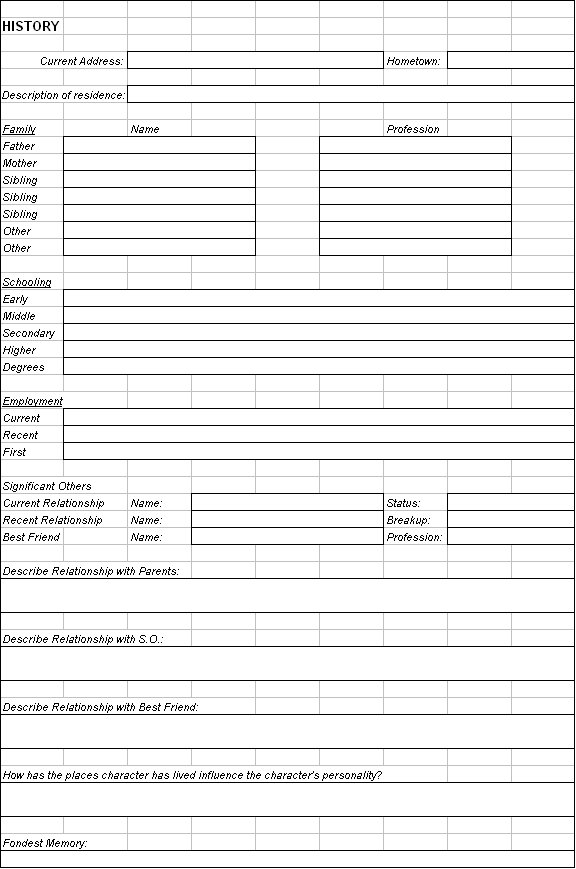
And now we come to the finish line of this marathon of character-creating industry. The fourth page of my character worksheet is dedicated to backstory, the history of the character. This page acts as a kind of resume, a curriculum vitae if you will (assuming the position being applied for requires a bizarrely intrusive exploration of relationships and motivations).

Here’s the page:

Fair warning: of the entire character creation worksheet, I skimp the most on this particular section. All of the information is achievable, but I find that though this information truly rounds-out a character, it most often fails to make the “final cut” of the manuscript. Not that it isn’t worth pursuing, but if you’re going to cheat, this would be the place.

HISTORY

Current Address/Hometown: This is the basic information, useful in nailing down the exact location of your character, as well as the character’s built-in filter of the world. A protagonist from Iowa will have a profoundly different view of the invading alien fleet than would the protagonist from Dubai.

Description of Residence: This is useful in keeping the details straight throughout your story. Does your character’s home have two stories and a basement, or just one story and a basement? Is it a red brick or a white siding home? Is it a mud hovel with a thatch roof, or a log cabin?

Family: Here, I progress through the basic family relationships, asking for names and professions. Names of family members, even those who do not appear in the story, become useful in keeping the character’s full history alive.  In The Curse Merchant, my protagonist had an Aunt that become so compelling that she worked her way closer to the front of the plot, until she managed to find a place in my plans for a sequel.

Schooling: So many of our early relationship are developed in school, as is our world view. Is the character a high school dropout? Did she receive parochial schooling? Does he have an advanced degree, and if so, is it appropriate for the story?

Employment: Likewise, the character’s skill sets have been honed in some manner prior to the beginning of the story. If the protagonist is school-aged, this many be left largely untouched. But what kind of biases come with having held certain positions? Is the antagonist averse to tipping? Does this annoy the protagonist who put herself through college as a waitress? This is a quick and easy way to build empathy and antipathy.

Relationship: Here I explore the character’s recent relationships. Assuming there is a Significant Other of some definition at play in the story, I’ll briefly define their status: girlfriend, fiancee, mistress, etc. The most recent relationship often interferes with the current relationship in some manner, so it is worth defining here as well… and may even provide an interesting secondary character. Then there is the Best Friend, however that character defines it. Some characters (villains, in particular) may not have an entry for Best Friend, as they are horrible, horrible people. And yet, if they are people, what are the odds that someone considers them a friend on some level? It’s worth exploring towards creating three-dimensional characters.

Describe Relationship with Parents: The single most formative influence on our world view are our parents. They defined our views of the opposite sex, the same sex, and of how families interact. They give us our first creeds, our moral compass, our religion, and our political views. When these things change as we grow older and independent, we may find we view our parents in an entirely new light. Or, we may grow to become carbon copies of our parents. The relationship of your character with her parents (living or dead, which is also worth noting) is a tremendous source of character bias and emotional development.

Describe Relationship with Best Friend: Very often the protagonist’s best friend acts as a reflection character for the protagonist, a character which has similar views or upbringing, but for one decision or twist of fate follows a different path than the protagonist. Explore the “what ifs” between the friends. How are they different? How do they serve one another as friends? This character is likely to receive his or her own character sheet.

How Has the Places Influenced the Character: If the white cop grew up in the Deep South during the 1950’s, that character might have a different view of his new black partner than would a character that grew up in Detroit. Did Princess Rowena of Planet Lesbosia really just give Captain Sarah Womanshield a lingering hug because she’s just friendly like that? We are products of our environment. Define how the character’s various environments influences the character’s world view.

Fondest Memory: I particularly adore this entry. When the plot gets tough… and it will get tough (if it’s interesting)… the character will experience a transformation. What is the bright memory that your character clings to during the Black Moment of the monomyth? Why is this a fond memory? Is it a trip with her parents to the ballet? What does this say about her current relationship with her daughter? Is it the day the hero’s father gave him his first sword? What has become of that sword, or his father for that matter? So often as a writer, I find that the fondest memories are defined by darkness. A memory is cherished due to its absence. Explore this fond memory, the pain of the character’s present, and the connection between the two.

And celebrate, because you’re done with the character worksheet! Now, make one for each of the other major characters.

I was asked if I would share my Excel templates with others who may find them useful. Whereas the Character Worksheet is something I cooked up on my own, the Scene Worksheet is the creation of another author, Meredith Bond. And as she uses this worksheet as part of a writing course, I feel it’s largely inappropriate to share it.  I have however uploaded both the Character Worksheet to Google Docs. Here is the link:

Character Worksheet

Thanks for following along… this has been a long series of posts filled with writing theory. Thus, for the next few posts I fully intend on lightening the mood with a little personal discourse and some thoughts on the elements of my current projects.

Tools for Pre-writing: Character Worksheet Part 3

Page Three of my character worksheet begins to needle into the minor details of the character, primarily the speech patterns and physical trappings which help in forming a mental picture of the character.  At this point in the planning process, I begin to skimp to a degree if I’m not dealing with a major character. But for my protagonist and antagonist, I do my level best to fill in every blank. Remembering of course that none of it is immutable, and will likely be overwritten by the time the manuscript is complete.

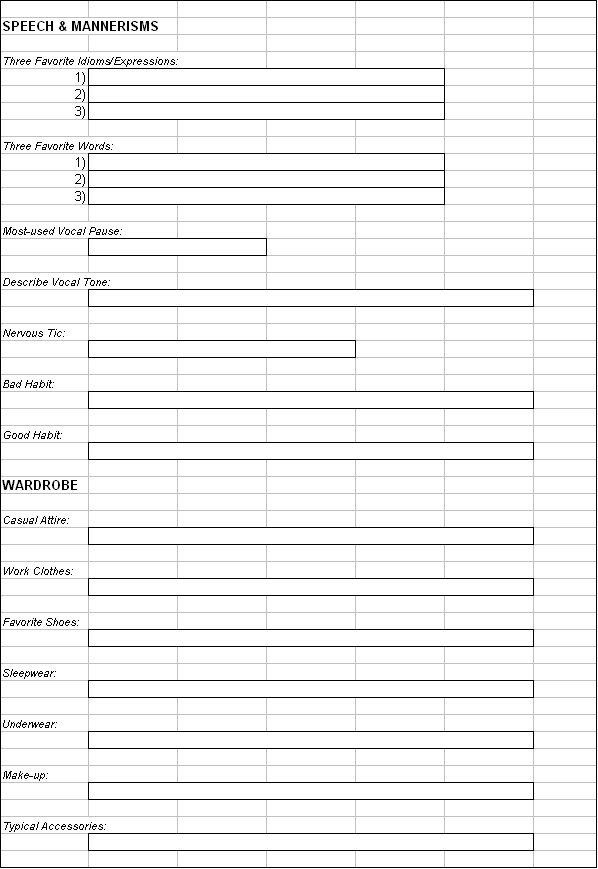
Here’s the third page:
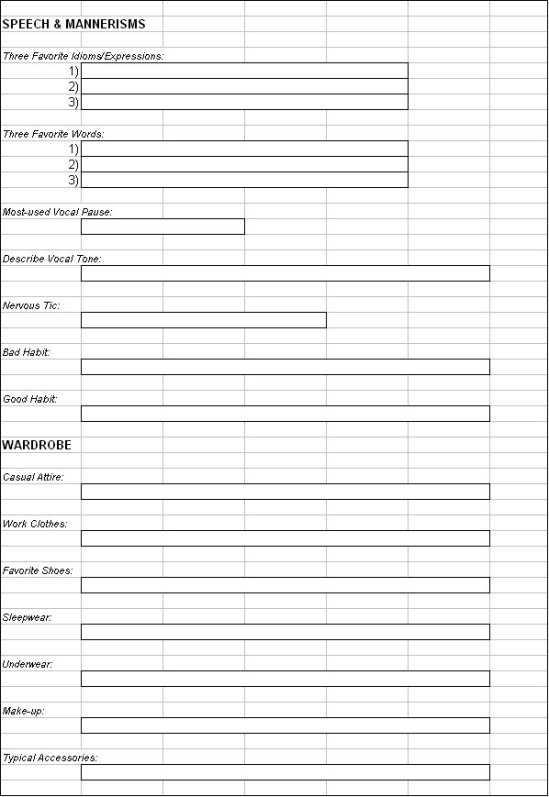
The value of the Speech and Mannerisms section is felt mostly in dialogue. Prior to making your choices for this section, go out in public and listen to real speech for a while. For The Curse Merchant, I actually filled out my character worksheets while sitting in the middle of a crowded community college cafeteria (I see the alliteration fairy is earning her pay this morning). Writing believable dialogue can be a challenge, but I find that filling in this worksheet can help keep my characters speaking at the level that I have intended for them.

SPEECH & MANNERISMS

Three Favorite Idioms/Expressions: In your prose, you should absolutely strive to limit the use of cliche and idiomatic expression. However, in your characters’ dialogue, idioms can and should present themselves. Define three idioms or expressions that the character tends to use, even over-use. Consider the personality of the character when making these choices, as they can serve to subconsciously remind you, and the reader, of the character’s mindset.

Three Favorite Words: I am a big believer in the psychological component of speech. Our diction carries hidden clues toward our personality. Choose three weighted words, keywords if you will, that may or may not pop up repeatedly in the character’s speech. Again, choose your words carefully, with respect to the character’s personality.

Most Used Vocal Pause: I don’t condone heavy use of vocal pauses within written dialogue. Even though dialogue is meant to be organic, it should never become distracting. Beginning every spoken sentence with “Uh, yeah.” or “So, um…” can become tiresome. However, this shouldn’t preclude the occasional use of vocal pauses, particularly during moments when you, as the author, have pulled the rug from underneath your character’s feet. In an effort to keep the characters distinct and identifiable within your manuscript, attempt to keep the chosen vocal pauses unique to each character. If your protagonist says “uh”, be sure the love interest says “hmm.”

Describe Vocal Tone: Just as knowing your character’s appearance helps to solidify the character for the mind’s eye, knowing the precise tone of your character’s voice will be equally formative for the mind’s ear. The description of vocal tone may often enter into the manuscript upon first hearing the character speak. Hint: I often cheat and describe a vocal tone simply by typing in an actor’s name. Wilford Brimley and Gilbert Gottfried have very different vocal tones.

Nervous Tic: Here we enter the realm of mannerism. Everyone has some type of “business” that is subconscious, yet often obvious (even annoying) to those surrounding us. Tapping a pen, clicking teeth, playing with hair, cracking knuckles, clearing the throat… these are actions that communicate anxiety, boredom, impatience. All by showing instead of telling. They also help to pace out a dialogue-heavy scene to give a moment’s pause for the reader.

Bad Habit: Beyond physical business, everyone has at least one bad habit. Poor dental hygiene, dirty laundry, bad accounting, procrastination. Go ahead and define a bad habit for each character. This is especially useful for virtuous protagonists or love interests who have a tendency to sublimate beyond the reader’s ability to empathize.

Good Habit: Not everything is nose picking and knuckle cracking. Just as virtuous characters require some manner of grounding, the more nefarious “heavies” in our plots often benefit from a humanizing element. Let them keep a spotless kitchen. Keep them on top of their bookkeeping. These habit entries are a kind of reflection of the Vice/Virtue entries in the previous page of the character worksheet, the distinction being that these habits should be mannerisms… mundane physical activities.

WARDROBE

Casual Attire/Work Clothes: For no particular reason, I tend to obsess on character wardrobe. Define a “typical” ensemble for day-to-day wear, and work attire. Whether these details enter into your manuscript is entirely up to the story itself. It must benefit the story, forward the character, or otherwise be beneficial to the reader. Otherwise it becomes verbal chaff. However, there is something to be said for implying a character’s personality via wardrobe versus straight exposition. The difference being “she was a quirky undergrad” and “she wore a poodle skirt, combat boots, and a Flogging Molly t-shirt”.

Favorite Shoes: There are entire schools of thought dedicated to the connection between personality and one’s shoes. If not, then there ought to be.

Sleepwear: Clearly important for steamy romance novels, but very often a middle-of-the-night scene will present itself, and should the character go sprinting into the night, it would be beneficial to know if she sleeps in the nude before the police catch up with her.

Underwear: Boxers or briefs. It may seem silly, but one’s choice in underwear can communicate elements of personality. When you find the woman wearing a leopard print bra-and-panty set undressing in front of the tax accountant wearing tighty-whiteys, the sexual dynamic rather presents itself.

Make-up: Bold emphasis on the eyes? Blood-red lipstick? Nothing but foundation? No make-up at all? Create in your mind a firm impression of the character, and as she develops throughout the story feel free to play with the choice of make-up, as the face she puts forward to the world tells a lot about the character.

Typical Accessories: The bracelets, necklaces, earrings, watches, wallets, belt buckles, and even the glasses frames find their way into the business of dialogue. Be sure to nail down exactly what the character is wearing, and keep it consistent within the scene!

Next time, we will conclude this exploration of character worksheets by creating the character’s personal history and resume.


Tools for Pre-writing: Character Worksheet Part 2

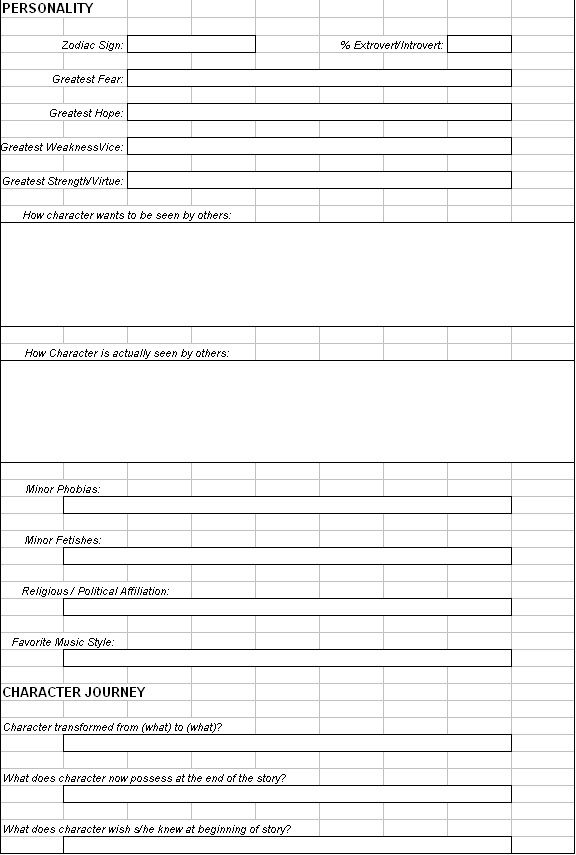
Today, let’s take a look at the second page of my character worksheet, which outlines the character’s personality and the character’s journey within the story. Here’s the sheet:

Let’s pick it apart.

PERSONALITY

Zodiac Sign: I know what you’re thinking. Seriously? Astrology? Views on whether the planets literally influence the lives of mortals aside, the traditional signs of the Zodiac break human personalities down into twelve archetypes… and that ought to get any writer’s mouth watering. I like to choose an arbitrary sign of the Zodiac, not to force the character to conform, but to give me a quick and easy star by which to navigate the character conflict.

%Extrovert/Introvert: How outgoing and proactive is your character? I choose a number to represent this, and try to keep it in mind as I wander through dialogue. I find this especially useful for secondary characters.

Greatest Fear: Name the one thing that would most devastate your character. Armed with this knowledge, you are poised to brandish this fear at your character. Repeatedly.

Greatest Hope: Similarly, the character’s ultimate dream should be something the character continually strives for. Tempt the character with this hope. Dangle it in front of her to urge her forward. This makes motivation much easier to define.

Greatest Vice: Keep this mundane. A vice is chewing nails, smoking, gambling, picking one’s nose, or picking others’ noses. It is thrown into the regular business of the prose between lines of dialogue and scene changes, and helps to ground the character in the mind of the reader.

Greatest Virtue: This is something that is utterly redeemable about the character, which the character doesn’t necessarily work at. It’s a constructive element of the personality that comes naturally. Does he always drop coins into the cups of beggars? Does he tip heavily? Does he mow the lawn of the old lady next door? Does he invest? These are the things that help balance antagonists. That is, unless you’re shooting for a perfectly cartoonish villain.

How Character Wants to be Seen by Others: This goes hand-in-hand with Greatest Hope, generally speaking, and defines the total package of character in the light of his hopes and ambitions, and helps to define the character’s “filter” from reality.

How Character is Actually Seen by Others: Here’s where the filter falls away. This entry combined with the previous entry can arm you with truckloads of dramatic irony for your character, as well as empathy (or antipathy) from your reader.

Minor Phobias: Do spiders give her the creepy-crawlies? Is he afraid of heights? These minor phobias often steer the character through the mundane business of life, and often present very real complications at the worst possible moments.

Minor Fetishes: Unless it’s integral to the plot, this is something that might not manifest in the story. The question remains, however, what turns your character on? This need not be sexual in nature. Does the character get a thrill from eating a triple chocolate sundae? Driving too fast? Dressing up in animal suits and playing tic tac toe on the kitchen table with a can of aerosol cheese?

Religious/Political Affiliation: We as human beings adore labels, particularly within a plural society. We carry within each of us a bevy of bias founded upon one’s own philosophies, be they political or religious. Depending on the story itself, this may be a very key, fundamental element to the plot. The more specifically you define their political and cosmological beliefs, the more concretely the character will present herself to the reader.

Favorite Music Style: If you answer Country/Western, and the story takes place in Renaissance Italy, then you might need to be sure that time travel is a core plot element.

CHARACTER JOURNEY

(this is a vitally important section to complete for any character)

Character Transformed from (what) to (what)?: This is a fill-in-the-blanks question. For any novel, you must have character development. Otherwise what was the point in the story? Most writers accept this on some level, but how deeply have you defined it for your character? Break it down simply. Your character began as a Blank, but has transformed into a Blank. Just fill in those Blanks. John transformed from a bigot to a compassionate husband. Judith transformed from a victim to an independent woman. Ughfrak transformed from a fifth-level demi-imp to a sixteenth level Demon Lord.

What Does Character Now Possess?: Your character may win or lose. When you get into the secondary characters, particularly the antagonist, you will have to deal with at least one character coming out on the bottom. Win or lose, however, each character will possess some knowledge, understanding, or even an item which represents the transformation the character has undergone. John now has a Korean wife. Judith now has a blue belt in Jiu Jitsu. Ughfrak now has the Greater Turning Stone of Beelzuboom the Filthy.

What Does Character Wish She Knew at Beginning of Story?: Part of the character’s journey should be painful. There should be failure, loss, even regret. And though our trials and tribulations define us and often make us stronger, we can’t help but to succumb to speculation. “Had I only known…” Define this speculation for the character. When the dust settled, what could have avoided all of this? Remember to keep this entry “filtered” through the eyes of your character.

Next time we’ll discuss Speech, Mannerisms, and Wardrobe!