The Theme of Downfall

Lately I’ve been obsessed with the concept of “Downfall”. And I’m not entirely certain why. I assume it has something to do with the current barrage of economic doom that assails my eyeballs every time I skim over Google News. Perhaps I’m reminded of it whenever I give my aging parents a phone call. It may even be likely that I’m standing on a turning point in my life as I take stock of what I have accomplished with my limited time here on Earth, and what I haven’t.

It’s not a particularly cheerful topic of conversation, but one that is nevertheless engaging. More specifically, I’ve found myself speculating on the future of the United States, and where our current situation will lead us. I can’t shake the feeling that we have seen irrevocable change in our time, and that this change can not be described as beneficial.
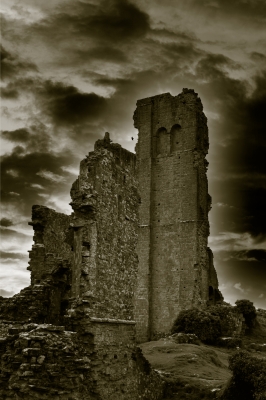
It's blisteringly difficult to hear Sousa in your head when you look at this picture.

So what has changed? Civil liberties (or our perceptions of them)? Social mores? The strength of the dollar? Our assumptions regarding life, career, and prosperity?

Recently, I watched a History Channel documentary based on Jared Diamond’s book “Collapse: How Societies Choose to Fail or Succeed“. The following week, I found my brother-in-law reading that very book on vacation. We had a long discussion on the topic (we were in Germany at the time, giving our conversation of the States a strangely appropriate distance from its subject), after which we both drank a great deal of beer to deflate the sense of doom we managed to conjure upon ourselves. As the weeks have progressed since that conversation, the doom has condensed into seeds of inquiry. What will become of America? Will it fall, in the Roman Empire sense of the word?

What is it about the concept of “Downfall”, or “krakh” as the Russians would say (thanks, Aubra!), that stirs such imagination? I have several theories:

1. We feel we deserve it. This goes with the whole guilt complex many post-agrarian citizens feel when disconnected from the horrors of literal survival. We feel as if we have been shielded from the brutality of Nature, thanks to our increasing mastery of technology and science. And as with a protective parent, we feel somewhat suspicious of our well-meaning bubble-wrapped existence. What happens when we lose our safety net (or our Blackberries, for God’s sake)? Have we brought this upon ourselves? Should we judge ourselves?

2. We think the good guys are losing. After all, aren’t we the good guys? Doesn’t everyone fundamentally feel they are playing for the right team? What does it say when the good guys lose? Surely, there must be some Great Author in the Sky who is simply leading humanity to its Dark Moment, after which S/He will write a last minute twist of fate, we’ll pull ourselves out of the mess by our bootstraps, and all will be well. Only, we really don’t believe that. Even those of us who believe in the Great Author in the Sky have the sense that S/He is pounding on the keyboard shouting “No, no… you’re WAY off the plot outline!”

3. Death is a rebirth. Humans have a profound distaste for finality. We as cognizant beings can’t easily accept death as an end, rather choosing it to be a doorway into a new reality. After all, if there is no human soul, afterlife, or rebirth, then we are faced with a crushing weight of futility in our existence. If there is nothing after death, then what would have been the point? I think we feel the same way about our societies. If our collective American Dream fails, then what would have been the point all this time? All these lives sacrificed? All of this hard-earned liberty simply squandered? On a core level, perhaps we feel that when the system is so thoroughly broken that it can’t be repaired, we must undergo a dramatic transformation that can only come through death. Perhaps we feel that the new existence will be an improvement? In a nation that treats Bankruptcy with casual disregard, I can see how this line of thought would hold.

I’ve noticed that my two active projects both have Downfall as its central theme. Omnipotence is a post-apocalyptic tale, set in the aftermath of a recent global cataclysm. The setting of the novel is not homogenous. Rather, I paint the different settings with different brushes. Not every city is in ruins.

The Curse Merchant has to do with personal Downfall. The protagonist embarks on a journey of corruption, witnessing the recent ruins of his personal life, forcing the question “how did it come to this?” Perhaps we’re all asking ourselves the same question these days?

There’s a morbid side to my reptile brain that wonders how bad it will get before it gets better. My more socially relevant friends assure me that my prognostications of gloom are largely unfounded. But I find it oddly titillating to consider a near future where society has transformed into something barbaric, totalitarian, anarchistic, or even utopian.

Because even though change isn’t always “good”, it is always “certain”.

Image credit: Simon Howden
Junk Words and Ego Deflation

As of this morning, I am one-fifth of the way through the first revision of Omnipotence. The process to date has been humbling. I’ve discovered several peculiarities of my drafting style which simply must be terminated. With extreme prejudice.

I routinely make jokes about my red pen, invoking as much carnal imagery as I can cram into a single idiom. Right now that carnage doesn’t feel particularly figurative. It’s real. I’m cutting and slicing my way through this manuscript like a Mongolian horde.

In the interest of deflating my ego, and in assisting others in their personal quest for the perfect manuscript, I thought I would share some of my personal editing bugbears which earned particular attention from my keyboard’s Delete key this week.

Or whatever your favorite editing tool might be... I'm not here to judge.

First is the infernal ellipsis. It seems I’ve developed a love affair with this peculiar punctuation mark. My manuscript is positively riddled with ellipses, but only in dialogue. I suspect this is due to my style of drafting, in which I pause when scripting dialogue to reproduce the pattern of speech as I hear it in my head. I won’t beat myself up too much over this. If anything, it indicates a real sense of prosody is weaving itself into my dialogue. However, a comma does the job just as well, but with an air of propriety and ease on the reader’s eyes.

Second, I’m running into weak verb structure. Again, I feel this is due to the sense of halting pace that comes with discovering the story during the first draft. However, most of the action is being watered down with the likes of the following:

“Nigel managed to set the coffee mug down before his knees buckled.”

“Horatio started to dust off his flintlock pistol as Lydia began removing her dress.”

These verbs are circling their sentences like fruit flies over a bowl of mangoes. It’s clunky and drags down the pace of the scene. How much better would it be to read:

“Nigel set down his coffee mug before his knees buckled.”

“Horatio dusted off his flintlock pistol as Lydia removed her dress.”

Much better. I feel like we’re getting to the point with greater efficiency.

Thirdly, the diabolical dialogue tag! Most writers I know have received a measure of advice at some point, guiding them towards the creative use of dialogue tags. Recently, I saw a photocopy at a community college Writing Center with a list of 100 synonyms for the word “said”, meant to encourage students to flower up their tags.

Unwise.

“Look at that!” Joe Jack bellowed alarmingly.

“Wow, that’s unbelievable!” Billy Bob sputtered.

Anna Rae mused, “It’s aliens, ain’t it?”

“Well, what else could it be?” Joe Jack grumbled in annoyance.

Horrid, isn’t it? To begin with, the use of adverbs in dialogue tags is almost never a good idea, for two reasons. First: there are ways of conveying the emotional context without using an adverb. “She barked” conveys the timbre of her speech better than “She said sharply.” Second: it’s even better to allow the dialogue to convey the context. Take a look at the last line of dialogue above. The phrase “in annoyance” is perfectly pointless. It’s quite clear that Joe Jack is annoyed. Why clutter the prose?

Dialogue in a scene with two characters doesn’t require dialogue tags to any great extent. A scene with multiple characters benefits from an economical portion of tags to keep the speakers straight. But in all cases, the perfect tag is the tag that the reader doesn’t notice.

Well, it is time to grab my revision machete and plunge into the manuscript once more. I will leave you with a quote from French aviator and writer Antoine de Saint-Exupéry:

“Perfection is achieved, not when there is nothing more to add, but when there is nothing left to take away.” 

Image credit: scottchan

Labor (of Love) Day and Plans of Attack

Happy Labor Day to all of my readers in the United States, and a Happy Typical Monday to the rest of my readers! In between mall shopping and grilling a few hamburgers, I thought I would take a few spare moments to honor the true meaning of the holiday and discuss my labor of love… writing.

First of all, the big news. I finished the first draft of The Curse Merchant last night! I was expecting a greater catharsis than I experienced, but I typed out the final sentence, made a Tweet to brag, and shut down my computer and joined my wife and her sister for one of my favorite Cary Grant movies. By the way, it was mind boggling hearing the term “dope fiend” in a movie shot in 1944. My usual euphoric exuberance gave me a miss, however, and I felt somewhat cheated by that. Perhaps after having written six novels (two in the last twelve months alone), I’ve come to a place where I more fully appreciate what the end of the first draft really means.

More work.

After I finish welding these plot holes, I'll take an angle grinder to that dangling participle...

Towards that end, I felt it beneficial to chart the last year of my writing pseudo-career and project forward. As one can never build a house without a blueprint, one can hardly be expected to progress along a career path without a plan. Strike that… a control freak with a penchant for flowcharts can hardly be expected to progress…

I began my fifth novel, working title of Omnipotence, in November of 2010. I completed the first draft in March of 2011. I resolved to sit on that first draft until I “fell out of love with it”, some advice I gained from Orson Scott Card. There is much to cut, much to rework, and much to polish on any first draft, and having any significant emotional ties to the baggage only makes it more difficult to be rid of it. Thus, I stuck it in my digital sock drawer until I finished my next novel.

Which was The Curse Merchant. I began outlining it immediately (truth be known, I was obsessing over the prewriting for Curse Merchant before I finished Omnipotence), in March of 2011. I began drafting in May, and took a four week break for a trip to Germany and to take my beer judge exam. I have now completed the first draft of Curse Merchant in the first week of September.

So, what now?

My plan is to immediately dive into the first revisions of Omnipotence, which after a long discussion with my wife is looking like it will entail a great deal of rewriting. I have no clue how long the first revision to Omnipotence will take, but I suspect it will be much longer than the single month I had planned.

In October, I will be taking a six-week course at Frederick Community College on manuscript editing, taught by Meredith Bond. I plan to bring the first pages of Curse Merchant in to that class for the group assignments, exposing it to the eyes of utter strangers. During this time, I suspect I will be in the thick of Omnipotence. At the end of this process, I’ll have a second draft of Omnipotence, and will likely need to reexamine the changes made. After I give the new version a good kick in the syntax, I’ll be looking for beta readers to catch what my wife and I couldn’t.

After that point, my plan is to begin outlining my next project, a western horror. That, I feel, will take me solidly into 2012.

So, there’s my immediate plan. I’ll post more thoughts on long-term plans on another day. But for now, the grill is calling my name!

Image credit: Sujin Jetkasettakorn

My Inspirations… Famous Author Edition

Recently I was asked who were my major influences as a writer. I found this question remarkably difficult to answer, and after a few days, I’ve decided it really shouldn’t take as long to answer as it did. I believe, in reality, I was being asked two questions at the same time:

1. Who do you like to read?

2. Whose writing can I best compare you to?

The first question is simple. But it is the second that gives me pause. I have to take a moment when anyone asks me to pigeonhole my writing. I even find difficulty describing my work within a specific genre. In truth, I bounce back and forth between science fiction, fantasy, horror, thrillers, and some manner of interstitial mind noodling between these descriptors.

Also, comparing oneself to a successful, even legendary author is an absolute death trap. I’ll never be Isaac Asimov. I wouldn’t want to lead anyone to believe I would ever think that.

Though to be fair, Asimov positively MADE those frames.

However, a prospective reader needs some kind of peg on which to hang his literary hat before electing to invest some of his or her personal time with your fiction. And so, without attempting to compare my writing to theirs, or to hint that I read these authors extensively, here is a very brief list of authors I feel have most directly influenced my style:

Arthur C. Clarke: The very first novel I had ever read in one sitting was 2001: A Space Odyssey.  I believe I was in the seventh grade, and had seen the Kubrick film only a few months prior. The movie thoroughly baffled me, but I found the novelization in the library (not the short story Sentinel upon which it was loosely based… long story), and wanted some manner of explanation for the electronic LSD trip that was the film’s third act. I was engrossed and missed dinner, and went to bed late (with my parents’ enthusiastic support) while reading it. I went on to catch myself up with Clarke’s major writings. I feel his ability to probe the extreme possibilities of reality in a terrifyingly familiar way is what really coaxed me at an early age into writing. Of particular note would be the Rama series, from which I still draw inspiration.

Philip K. Dick: The man’s corpus of writings has served as source material for countless Hollywood science fiction endeavors, often with great success, often with horrifying disaster. Dick’s views of reality as something not entirely tangible, certainly mutable, and ambiguously malevolent, provided me with a craving to find those plot hooks that would capture one’s imagination.

Kim Stanley Robinson: Thanks to a science fiction literature course at Louisiana State University, I was introduced to Red Mars. I was a distracted, cocksure undergraduate with only a half semester left before graduation. I was also obsessed with a mission to use the word “cocksure” in a sentence legitimately. Mission accomplished. Robinson’s Mars Trilogy provided me with an enormity of inspiration, particularly with his sweeping epic scope and his dedication to character-centered drama. His writing also showed me how sociological commentary can elevate a well-crafted story into something of greater worth.

I enjoy reading the works of more authors than these, by all means. But if hard-pressed to point to three writers whose works have most directly guided my thinking as a storyteller, these would be the ones I would choose!

In other news, The Curse Merchant is three days away from its deadline. I have at the writing of this blog post only 10,000 words left to fill. It may require long evenings, but it is possible to finish. Possible… perhaps not probable.


Back in the Saddle

The three week hiatus has now passed, and as promised, I am back at the keyboard!

For the record, the vacation was outstanding! For further record, my exam the following weekend went very well, and with any luck I’ll get good news about that exam sometime between now and Christmas.

But back to writing! I have a plan in effect… I will finish the first draft of The Curse Merchant by September 1st. Doing the math, I feel I can make 80,000 words if I write 1300 a day. That should be no problem at all. My average work-week productivity is closer to 2000 words, which means I’ll have a thicker first draft to whittle down come revision time.

Forward, march!